JavaScript is disabled for your browser. Some features of this site may not work without it.
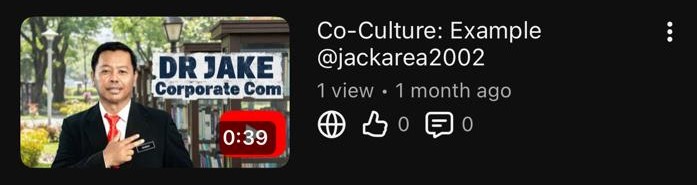
Co-Culture
DASAN, JAKARIA
Date:
2025-10-26
Links:
https://youtu.be/64Qi2DqZ3MM
Abstract:
Co-culture, or subculture, refers to a smaller cultural group existing within a larger dominant culture. Members of a co-culture share unique values, norms, beliefs, and communication practices that distinguish them from the mainstream society while still interacting with it. These groups may form based on ethnicity, religion, profession, hobbies, or other social interests, and they influence how members perceive the world, communicate, and behave.
Understanding co-cultures is essential for fostering effective intercultural communication, promoting inclusivity, and appreciating diversity within educational and professional environments. Co-culture dynamics can shape identity, social networks, and decision-making processes, while also affecting perceptions, conflict resolution, and collaboration. Recognising co-cultural patterns helps students and professionals navigate social interactions with sensitivity, respect, and awareness, bridging gaps between different groups within the larger society.
This knowledge equips individuals to analyse social behaviour, interpret communication cues accurately, and adapt strategies for engagement across multiple cultural contexts, preparing them for increasingly diverse academic, organizational, and community settings.
Description:
Co-culture refers to a subgroup within a larger society that shares its own distinct values, norms, and communication patterns. Understanding co-cultures helps students recognise diversity, navigate social interactions, and engage effectively across different groups while maintaining respect and inclusivity.
Metadata
Show full item recordFiles in this item
This item appears in the following Collection(s)
-
Educational Videos [224]
Search OER@UMS
Browse
-
All of OER@UMS
-
This Collection
My Account
OER UMS by Universiti Malaysia Sabah is licensed under a Creative Commons Attribution-NonCommercial 4.0 International License.
|
JTMK copyright © 2017 Copyright Reserved (UMS) Universiti Malaysia Sabah Jalan UMS, 88400, Kota Kinabalu, Sabah, Malaysia Phone: (+6088) 320000 atau 320474, Fax : (+6088) 320223 |